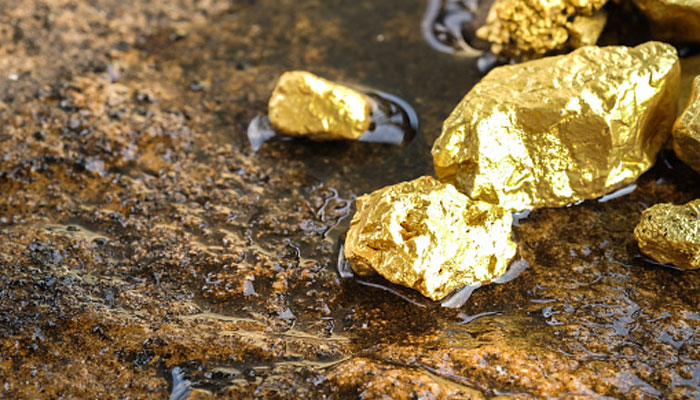
Uganda Discovers 31 Million Tons of Gold Ore

Uganda's gold


Recent exploration surveys in Uganda have led to the discovery of approximately 31 million tons of gold ore deposits, from which an estimated 320,158 tons of refined gold could potentially be extracted, with its value currently standing at $12.8 trillion.

The results were announced following two years of aerial exploration followed by geophysical and geochemical surveys and analyses.

Announced in June by Solomon Muyita, a spokesperson for Uganda’s Ministry of Energy and Mineral Development, the country is seeking to attract international gold mining companies and investors, having already licensed Chinese gold mining firm, Wagagai, to start production in the country’s eastern Busia District this year.

Announced in June by Solomon Muyita, a spokesperson for Uganda’s Ministry of Energy and Mineral Development, the country is seeking to attract international gold mining companies and investors, having already licensed Chinese gold mining firm, Wagagai, to start production in the country’s eastern Busia District this year.

The firm has invested $200 million towards the construction of a refining facility and is expected to refine approximately 5,000kg of gold per day in Busia by the end of 2022.

In a bid to overhaul its economy, Uganda’s President, H.E. Yoweri Museveni, has sought to ramp up investment in the country’s mining sector to develop its reserves of copper, iron ore, cobalt, phosphates and gold. Refining gold locally is expected to lead to the generation of 3,000 direct jobs while improving social service deliveries to local communities.

Earlier this year, Uganda’s Parliament enacted a new mining law, pending the President’s approval, that will lead to the creation of a state mining company through which investors will be required to sign a production-sharing agreement, allowing the company to acquire a 15% stake in mining operations within the country.

The majority of ore deposits were discovered in the northeastern region of Karamoja, with large reserves having also been found in the eastern, central and western areas of Uganda.

Comments

Popular posts from this blog

3 places you should visit in Italy

1. Florence: Famed for astonishing craftsmanship and engineering will help you to remember the period of Renaissance, Florence is one of the most heartfelt urban communities in Italy. It is notable for its shopping industry with numerous high fashion stores and serving lip smacking Tuscan cooking. 2. San Gimignano: One of the most intriguing spots to find in Italy for a laidback excursion is the little town of San Gimignano. It is perceived as an UNESCO world legacy site and interests everybody with its middle age places of aristocrat groups of Italy. 3. Rome: Boasting of the most lovely places to visit in Italy, Rome charms everybody with its cobblestoned roads, small shops and heartfelt cafés. One can enjoy various exercises here that reach from visiting the Colosseum to glutting on the best pizzas on the planet.

The Bermuda triangle

The Bermuda Triangle, otherwise called the Devil's Triangle, is a metropolitan legend zeroed in on an approximately characterized locale in the western piece of the North Atlantic Ocean where various airplane and boats are said to have vanished under baffling conditions. The possibility of the area as particularly inclined to vanishings emerged during the twentieth 100 years, yet most respectable sources excuse the possibility that there is any secret. The earliest idea of surprising vanishings in the Bermuda region showed up in a September 17, 1950, article distributed in The Miami Herald (Associated Press) by Edward Van Winkle Jones. After two years, Fate magazine distributed "Ocean Mystery at Our Back Door", a short article by George Sand covering the deficiency of a few planes and ships, including the deficiency of Flight 19, a gathering of five US Navy Grumman TBM Avenger torpedo aircraft on a preparation mission. Sand's article was the first to sprea...

ARTEMIS PROGRAM

The Artemis program is a robotic and human Moon exploration program led by the United States' National Aeronautics and Space Administration (NASA) with three partner agencies: European Space Agency (ESA), Japan Aerospace Exploration Agency (JAXA), and Canadian Space Agency (CSA). If successful, the Artemis program will reestablish a human presence on the Moon for the first time since the Apollo 17 mission in 1972. The major components of the program are the Space Launch System (SLS), Orion spacecraft, Lunar Gateway space station and the commercial Human Landing Systems, including Starship HLS. The program's long-term goal is to establish a permanent base camp on the Moon and facilitate human missions to Mars. The Artemis program is a collaboration of government space agencies and private spaceflight companies, bound together by the Artemis Accords and supporting contracts. As of July 2022, twenty-one countries have signed the accords,[6] including traditional U.S. s...